
Neurodivergence in the face of a modern gaming collapse and retro gaming resurgence
Col Clark July 2026
I have spent the last two years of my life recompiling and amassing new elements of my retro game collection. My spouse and I finally pulled the trigger and bought a 32 inch, 250 pound monstrosity of a CRT to which I have hooked up every.system.I.have.ever.owned – NES, N64, PS2, Gamecube, Wii, and a non-functioning Xbox 360 – as well as one I missed out on in my childhood – a beautifully preserved SNES. To say it is the culmination of my life in gaming is an understatement. There are game cartridges on my shelves I played when I was 4-and 5-years-old on the NES which was plugged into an ancient television in my childhood home’s unfinished basement. We’re talking a 1976 Sony CRT at best. I used to sit on the end of my father’s 1980s treadmill and stare up at the glowing wood-paneled monstrosity with absolute wonder as I worked my way through Super Mario Bros. 3 or the original Final Fantasy – which basically taught me how to read proficiently. Now I can sit two feet away from an early 2000s era Sony behemoth, very same controller in my hand – which admittedly feels absurdly small these 33 years later – very same pixels rushing across the screen, and I’m instantly taken back to a time of wonder. The same goes for any of the other consoles. I slam out some Tony Hawk’s Pro Skater 2 challenges and remember my sister opening the box as her very last present during her own 5-year-old Christmas… and I find peace. Nostalgia is a wonderful thing. Unfortunately, it is also a kind-of depression-lite. We’re brought back to a time we view as simpler, more peaceful, and – for me – more full of promise. The entropy of my entire future laid out before me, unknown and mysterious.
Slam cut, and now I’m 37 years old. And I know how things shook out. My twenties were a hellscape. But I quickly settled into my 30s as a “better person” and finally began to figure out who I am. I was diagnosed with Autism shortly before my 31st birthday – a diagnosis which whip-cracked my entire life into immediate relief and focus. It made everything make sense. It explained my lack of emotional regulation, and why – despite countless hours of therapy as well as a barrage of depression and anxiety meds – nothing had seemed to truly release my ever-present feeling of unease and wariness concerning the world I moved through. But even in those dark years, between train hopping, almost failing out of college, getting divorced, and more than one suicide attempt, gaming was my ever-present escape. Gaming let me be someone else. Perhaps that’s why I fell so hard for JRPGs and narrative heavy games like Life is Strange. I got to not be me for a while. That has always been a blessing.

In building this new collection, along with my intense foray into emulation and handhelds, I’ve caught up on many of the series I missed throughout my three decades in gaming. The one that always stands out to me – my most important, memorable, and “holy shit I’m glad I finally played this” item amongst my myriad-dozens of games is Legend of Mana for the PSX. Released in 2000 in North America – a very late PSX game – Legend of Mana is a sneaky monster of a convoluted RPG only suitable for a very select type of player. I don’t say that to lord it over anyone saying “well, you just don’t get it”. I say that with the vibe of, like “this game might be for no one…”. When I found Legend of Mana at a retro game convention last year, I’m under the auspicious belief that my generous spouse could immediately tell how much it meant to me. She offered to snag it for me – gift giving is her love language, one I’ve done my best to adapt myself around and just graciously accept. My unregulated body movements and tone of voice must’ve given me away immediately. The “crab clamps” are a dead-set tell.
I had – up to that point – blasted my way through most of Secret of Mana and all of Seiken Densetsu 3, Legend of Mana‘s direct predecessors. Seiken Densetsu 3 may well be the most impressive and ambitious title to ever grace a Super Nintendo cartridge, and I maintain that the fact it never made its way stateside as one of Square Soft’s most heinous of sins and blunders. Sure, we got a full-blown remake in the form of Trials of Mana in 2020 – during the kickoff of the pandemic, no less – but the true and godly way to experience what Koichi Ishii and Hiromichi Tanaka gifted upon a system already chockablock full of classic JRPGs is to take the scoundrel route and procure yourself a bootleg cartridge from the depths of the world wide web, containing within that grey block the unofficial English translation, so as to witness the power and glory that is Seiken Densetsu 3‘s immaculate art direction, classic soundtrack, compelling story, and wholly unique game-play on honest and real grey and purple hardware, wired directly to whatever form of Cathode Ray Television you can get your grubby mitts on. I’m not trying to be a hardware elitist – I even spend most of my current retro gaming on an AYN Thor or RG34XXSP. But it is something else entirely to make your way to the Mana Tree with your chosen triad of heroes as historically accurate as humanly possible.
This here is where enter in the bummers. Retro gaming has gotten accursedly expensive and all but unapproachable to anyone but the most dedicated. A hobby that used to boast some of the cheapest ways to experience the best that the art form has to offer has been soiled by the ever-present demon of late-stage capitalism. And this price increase is coming from the top down. You want to know what real “trickle-down economics” are? What’s currently happening in gaming is a text-book case of its true ramifications.
The second week of July, 2026 may have been the most impactful week in the games industry in recent memory. We witnessed a double-whammy of C-Suite dumbassery from the two ever-warring cesspools that are Sony and Microsoft. I swear to fuck that they’re both attempting to out-stupid each other in a race to the bottom. First, Xbox announced it would be selling off or shutting down a slew of their all-to recently acquired studios. The list is made up by Ninja Theory, Compulsion Games, Undead Labs, Arkane Lyon, and perhaps most notably to those of our ilk – Double Fine Productions. And simultaneously, Sony announced that it would end the production of physical discs as game releases come 2028. I ask you: why do we support these disgusting organizations when we have such an easy out? We can cut ties with both of these companies, go emulation- and PC-side, and own our media. Good Old Games, while limited, is doing it the right way. And there are companies out there making physical media important again. Yes, we don’t “own” our steam games. But we will never feel the wrath of a company boxing us into their paradigm of “we own you and we own everything you own” diaspora of late stage capitalism.

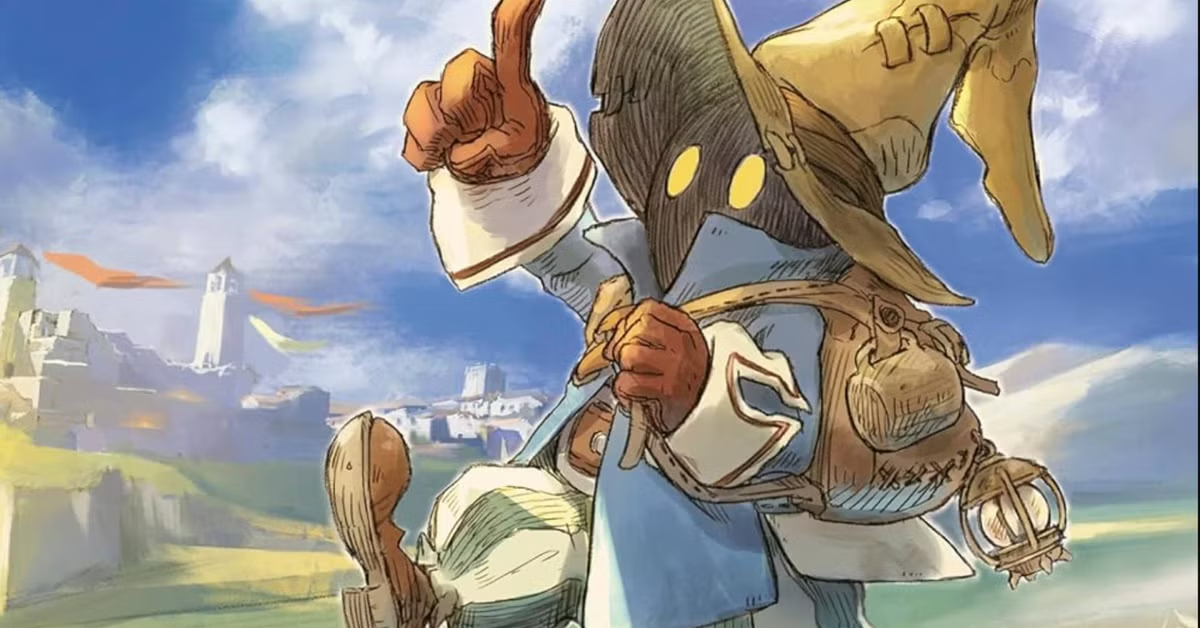
Here lies the rub. We have an option. We live in an era of gaming – neigh 50 years into the medium – of turning back and looking forward simultaneously. It’s the same way we attempt to present ourselves as neurodivergent humans. We try to mask and fit in where we can, while we still find avenues to let loose and be our true selves. It’s a tight-rope we walk. To honor our past and relive the games we never got to experience on real hardware, and simultaneously sticking it to “the man” on where we want our games to exist. We, as neurodivergent, want to exist in the space we want to create, while simultaneously having to exist in every-day space. We mask. We hide. We secret. We low-down. We trod. We cut out. But we have a space to thrive. And that is the space of retro gaming. You’ve heard it from so many others. Hear it again, now. We don’t have to hide here. We exist here. We are ourselves here. We are speed-runners, and hackers, and collectors, and historians. We are ourselves. Exist here with me. Exist here with us. You can find home here. Go speed-run Final Fantasy IX and be free, you freak <3.
Leave a Reply