Sam Vu Nguyen – June 2026
Make everyone else and I see me for me.
Be it the indoor cameras my parents have purchased, aliens, or some “Truman Show-esque” situation, there are cameras inside my house, and judgement lingers in the back of my mind. I – and everyone in existence – have heeded the ways in which our actions have influenced others in the perception of ourselves amongst our inner, and outer circles. This kind of surveillance hasn’t recently manifested itself, so why do I do so much for an invisible eye?

Raised in an immigrant household, there was a sense of impermanence that filled our lives. We moved quite often, and in the grace periods when my family would settle down, the looming threat of bills, work stability, and taking care of 2 shy, picky, and relatively non-social children certainly held an air of transience over us all. In the midst of this were family friends on their own journey – their own kids and their own lives – and I’d hear, repeatedly, the same three things in conversations between my parents: bills, work and children.
There were elements that remained firmly stable, of course, such as documents, report cards, interview transcripts, medical records, photographs, and the like that lie in old plastic boxes somewhere. Static, they tell a story; a brief glimpse of the past, a short flicker of what our family was up to that moment, and what else we might have become.
From these new-age developmental milestones drilled into the walls – and the brains of us kids – the idea was now focused on who could reach the top of the bar. That I, like many others, was pushed, urged and invested on to see how high we could climb the academic ladder. I was a lost, shy, inattentive and fidgety child, so I simply followed whatever my parents told me. I pursued all of the instructions laid before me in such a manner so that we could reach the summit, and for once feel the permanence placed at our feet.
This permanence translated to our online worlds; social media was becoming an increasingly prevalent aspect of our lives, the expectation of having an online platform to communicate when not physically present was more of a mandatory presence than a request. These platforms we created, the image we represented ourselves with, the photos we showcased, the movies we watched, it had appeared to me that our image was that of what we displayed online, what we chose to do, and chose not to. Anytime I commented on a random post, it was as if I was popping out my head for the world to see me; I was leaving a small, yet permanent footprint – the culmination of what I chosen to show others.


For many of the recyclable trash Cairn’s protagonist, Aava finds lying around, a rare map takes form showcasing possible routes once drafted, tested and climbed by those who had trekked or lived on Mount Kami in its past.
These makeshift signposts, once meant as a guide to potential climbers, stood to me as a scale of distinction, judging me in an assessment as a climber, consumer of games, and all-around person.
I play Aava, legendary climber, mountaineering prodigy, and sponsor-backed daredevil. I finish difficult games, as I, among countless multitudes, have felled gods and raging spectres of the past (neither is my footage, obviously, but I do hold defeating the former before they were nerfed somewhat proudly in my heart). Though I had correlated games as to art for ages now, there was a part of me that innately focused on the objective: “This isn’t done until I beat X, so I can feel Y”.
I had come into the possession of a sheet of mapped routes – one for the wall ahead of me. It was not already enough to summit a treacherous mountain, but that I had to climb the harder routes. If others have completed this game with fewer handicaps, then by comparison, this was just merely an assessment of if I was even fit to claim the hobby I had such a history with. When speaking to others about our experiences playing Cairn, a part of my mind remained latched onto the idea of climbing correctly; that the path I took, and the experiences I garnered were at the very least tangential to general opinion. Unlike Aava, who vehemently is not interested in documenting her journey, it had impacted the way I had climbed as a result.

On the way to the summit, Aava meets a younger climber and fan, Marco. During their second encounter, Aava rebuts Marco’s deference from reaching the summit as defeatist, almost lackadaisical. When Aava looks for the summit, she looks at sorting her limitations into the binary of can and cannot. As she surpasses herself; she does not stop to think about stopping. It is as if the physical record of the accomplishment is ingrained in her, and – therefore – in me. Either you beat it, or you shelve it. And for the time you’ve invested in yourself and your hobbies, you almost never want to shelve it.
Would you ever think to stop? Who reached the summit of the Giants Needle from the north side but Aava? While meaningless in a vacuum, the achievement is told by a raving Marco as this distinguished task, a fantastical demonstration of the human physical instrument. Noted in the autobiography written by your father, you started this when you were three. And quoted by Marco himself, he is nothing but awestruck in meeting you. This is how people see Aava, pre-defined from the start..
And that’s how I saw myself. The only hobby that has stuck for as long as it has, for me, has been videogames. As an indicator of my age, I would play games on my tablet when being driven to school, I would dedicate my small monetary gifts and hundreds of hours on free-to-play shooters. I would ignore my studies and extracurricular practice just before I would leave for school to hold onto the only hobby that felt dopamine inducing; just for a little bit longer. I dedicated the majority of my life to the screen as a child, and more as a teen. I have repeatedly asked myself if all this time must have been for something; that I needed to translate this to anything, for the wall I had not climbed to be so visible, the one I took had to be just as good.


Comparison is the thief of joy. In addition to guide maps and the map legend of difficulty, Cairn follows your individual journey up the mountain marking it as a multi-colour line. The colours range cool to warm toned, relative to the amount of effort and exertion Aava experienced during the climb. When I play as Aava with the walls I climb passing, are they ones Aava would have chosen? Did I fit into what Aava would have done? Or am I playing as myself? Would the walls I had ignored for sheer difficulty the ones Aava would have scoffed at? Did I so easily miss a jug for my hands or a slope to leverage my feet? Climbing Mount Kami had me plagued with this idea of these differences. I had believed that I had gotten a hold on the mechanics, a small hold on the mountain. But was there something I might have missed that everyone else simply achieved.
Cairn tracks everything, including death – your failed climbs, the times where you fall to your demise, your former trail now washed with dark grey. For the default difficulty, Cairn drops you off at your latest save point, they’re seldom seen, and like the bonfires of Dark Souls 1, they are a wave of relief.
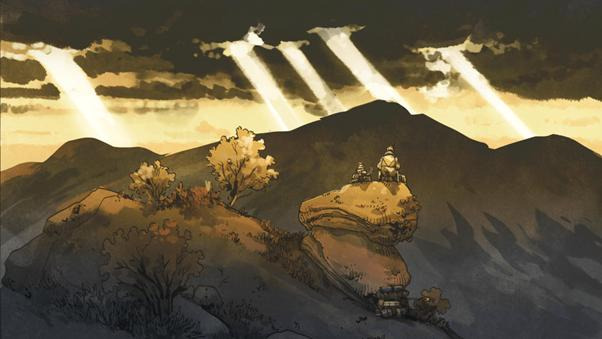
Another grey line gets drawn, and I leave my tent once more. This has been my 150th fall, and my 45th death, but still I continue. There is always some drive in failure that gets me to keep climbing, it’s an addictive process. I walk outside, past my tent, and I am surrounded by curtains of grey shrouding Aava before the ledge. I am draped in mistakes, held up by what-ifs. It had blinded me from looking out at Cairn’s beautifully crafted skybox and horizons, reminding me as to why it was all so endearing. It was these thoughts that made me finish the game. To think about the climb long after summiting Mount Kami, to why I see Cairn as a game about self-reflection.
I have lived and breathed the same way I played games, and by extension – life: by the binary of white and black, and Cairn presents me with grey.

Before reaching the alps and ice fields of Mount Kami, Aava meets Damas, a former climber who has been paralysed by expectation and shame and has himself holed up in purgatory on the mountain between the threshold of confronting himself and his own perfectionism. Forever mentally stuck, and living off the supplies of climbers past who had dared to climb past him – despite his warnings, his resentment stirs for others who were once as foolish as he, and for himself for not having the strength to address his own crippling dysfunction.
Though I embodied Aava, I saw so much of myself in Damas – one so immobilized by his own self-loathing and own perfectionism that he cannot permit himself to stop. All this time spent living and breathing Kami, he has cemented his time, life, and career to this current moment; leaving Kami would be surrendering to the idea that everything was for nothing.
Only you may decide if finishing the climb to Mount Kami is worth it. Damas shows you bodies upon bodies, and bags upon bags left by the perished. It comes down to whether or not you’re doing it for the world, or for you.


In completing the game, Cairn permitted me to recall my entire trek, painted by a singular line. One without deaths; a clean outline of my decisions, achievements, and choices, marked with everything that had caught my mind. From the walls I had committed to climbing, to the minor and major falls that brushed against death itself. Static, they tell a story, a brief glimpse of the past, a short flicker of what I was leading up to that moment, and what else I might have been. But what might have happened does not subtract from what we are now. For we are ourselves, and only ourselves – for the walls we climb should always strictly and proudly be our own.
Two roads diverged in a yellow wood,
and I took the one most travelled by
It was littered with corpses, as such roads are
But you will have noticed, my own corpse is not among them.
-SVN
Leave a Reply