
Colin Clark
Let me make you a deal, I’ve got four incredible game recommendations loaded in the chamber. Not just any game recommendations. These four come from my recent brain throbbing doom spiral descent while on the hunt for the most intrinsically motivated gaming experience I could find. But before we get to the games themselves, we need to talk. Gaming has a problem, and I have succumbed to it in an incredibly detrimental way. It seems too often that developers rely on extrinsic motivation and seemingly forget that their game should also be fun to play. I have a list of four games from developers who didn’t forget that. Let me explain.
“I am bad at video games.” I have been an ideologue to this concept for as long as I can remember in my life as a “gamer.” I remember sitting down to play Super Mario Bros. 3 on a family friend’s NES when I was about 4. My first ever experience with a controller in my hand and something to control on a screen. I died to the first goomba. The highschool kids watching told me to try again, and to press A to jump over the goomba. So I went again. And I failed to jump over the goomba. And I died again. But on the third try, not only did I jump over the goomba, I jumped ON the goomba – by sheer luck – squashing it under Mario’s boot. From that exact moment, that exact frame on the 1993 television in the basement of a suburban home, I was hooked. The problem is, I have lost sight of that feeling in the 30 years that have followed. What hooks me now to games is *narrative*, followed so very closely by *progression*. And – as Chase Allhart of Videogame Podtimism has coined it – I am a “ding-boy”. I like when numbers become bigger numbers (though not necessarily in the case of score). I like when swords get traded out for bigger swords. I love when shoulder-pads get traded out for bigger shoulder pads. Swoon. So if you combine those factors, it’s no wonder that RPGs are my favorite genre.
I also, like many others, unfortunately, am a sucker and a mark for true extrinsic motivation and Skinner Boxes in gaming. I get sucked into the wanting of a reward for my moment to moment activity. Except what I’ve come to realize embarrassingly recently is that games are often at their worst and most problematic when they require us to subsist purely on those two motivation techniques. I will grind for hours through an eldritch JRPG – not truly enjoying the beat by beat gameplay of my session – just so I can be drip-fed my little morsel of lore or narrative development or new piece of gear or ability. Just to then return to the same gameplay that is, often, a slog at worst and mediocre at best. A little snack of dialogue after a grueling hour of whacking Cloud Golems, inching my characters upwards a few more levels so I can finally beat that goddamn Gasputin boss – which I don’t even have fun fighting because I’ve already done it three times – so that I’ll be graced with a bit more story progression and the chance to see what awaits me next. Which, more often than not, is more tedium. And I will graciously lap it up and bleat “thank you, Horii-San, for your masterpiece. I am unworthy.” Just because Dragon Quest is my favorite series of all time doesn’t mean I don’t have some hefty critiques to level at it. I have, in the past, sat for thousands of hours on an MMO grinding out dungeons in the hope that the one piece of gear I want will drop, mindlessly slogging my way through corridor after corridor, boss after boss, toxic party after toxic party. And then I’ll do it again. You wanna know what madness is? Repeating the same behavior and hoping for a different end. Let me put it this way: it is by sheer miracle alone that I don’t have a gambling addiction. What I do have is ADHD and therefore a dopamine deficiency. And, most problematically, a lack of willpower and a drive to do almost anything to re-up my brain’s supply. To levels of embarrassment, drudgery, and even actual self-harmful actions. I wish this shit would at least have the decency to leave my hobbies alone, man.
At the risk of redundancy, I must again make plain my case that games are at their worst when purely driven by extrinsic motivation. Every single genre is being forcefully injected with RPG mechanics to trick players into coming back and sticking around. They use it as a means to hide how truly god awful the game is without the tacked on “progression and loot system”. Good developers know – “intrinsically”, you might say – that a game is mostly worth it’s weight in intrinsic motivation. We don’t play games to simply fill up the hours in our day, goddammit. We don’t have extra hours in our day thanks to our current state of affairs and the plague that is late stage capitalism. So why, then, will I spend 25 hours on an idle game, watching the numbers go up, experiencing negligible in the moment enjoyment only to look back on the entire experience and throw my hands in the air, saying “what the hell?!”
I dive the depths to a level of delirium into the myriad variations of the all-powerful JRPG like it’s my sole purpose in life. The more convoluted the narrative, progression path, and mechanics, the better. Titles like Vagrant Story, Legend of Mana, and Chrono Cross come to mind as popular references. I even don’t hate the combat mechanics of FFVIII. Sure, those I’ve listed have most certainly given me far more intrinsic enjoyment than say, your Legend of Legaias and your Koudelkas. I’m so sorry, Koudelka, I love you, but your battle system is pure muck and mire. Needless to say, “extrinsic” motivation has become my de facto reason for gaming, especially in the last few years. I’ve recently set up my entire childhood’s worth of games and consoles on an ungodly heavy CRT in my office. I have sunk hundreds of hours re-spelunking the depths of the PSX, PS2, and SNES consoles for all the narrative and progression systems they can throw at me. I wonder, though, about the balance of intrinsic and extrinsic motivation in narrative and progression systems.
Is enjoying a game for the story motivating me out of intrinsic or extrinsic motivation? Can I argue that I’m gaining something tangible? Is that not an outcome or goal? Here’s the conundrum: The lines between intrinsic and extrinsic motivation blur so significantly in gaming that it seems one simply can’t exist without the other. One clarifying factor comes from the fact that extrinsic motivation from outside forces. So even if you’re intrinsically enjoying a narrative, you’re hoping that the outcome is that the developer will continue to provide you with continued enjoyment. This, to me, is so clearly evenly balanced blend of extrinsic and intrinsic motivation only seen in gaming. The difference between intrinsic enjoyment in a game story and, say, a novel is the factor of participation. The game requires your direct input for it to continue forward in a way that reading simply can’t touch. Don’t get me wrong, I’m an avid reader – I have a degree in Brit Lit, for all the good it’s done me – and some of my favorite games can go on for significant amounts of time consisting of just reading. The Kiseki, or Trails series, in particular, I basically treat as reading before bed. Most of Falcom’s epic series even has a function that automatically advances the text boxes so you don’t have go so far as to, gasp, press a button to advance. I’ve seen text-driven cut scenes go on for up to an hour of reading. However, at some point, eventually, even Trails of Cold Steel IV returns to game play, requiring your participation and switching to a heavier dose of intrinsic motivation. That is, at least, if you are enjoying the battle system and exploration. And, yes, there are visual novels. But if there is truly no game play, even if visual novels are considered games, is there any intrinsic motivation involved? I want to say yes, as intrinsic motivation still derives, at times, purely from a sense of curiosity or personal enjoyment. But it doesn’t feel like that pure, uncut intrinsic shit. Again, intrinsic and extrinsic motivation are two heads of the same coin, but that coin is never so thin as it is when created by gaming.
#4 – rez

So, then, as these circular and maddening thoughts and wonderings have spun around inside my noggin, you can imagine how almost jump-scared I felt in discovering that my most recent motivation, and sole purpose in firing up a video game is to experience the most heady and crystal clear intrinsic motivation I can find. I want nothing more than to enjoy every split second of minute to minute gameplay, even at the expense of any extrinsic motivation, be that narrative or progression. It’s just not how I’ve done things ever before in gaming. This yearning first kicked off during my affair with Lumines: Arise (which you can read about in all it’s panic-inducing hectic tears here) and it’s “one more run” vibe and presentation of minimalism and beauty. However, since then I’ve found myself more and more sucked into similar types of experiences. Those that don’t necessarily have a narrative at all. Or even a progression system outside of, say, unlocking a new skin for the falling blocks you’re working with. I first went back to Rez, Enhance’s first major production, and, although I play it at least once every six months or so, I found that it held up even more exceedingly well than usual due to my current appetite. The beat by beat flow state gameplay hooked me stronger than it has since I was 12. Half rail shooter, half rhythm game, Rez has you controlling a crosshair and a digital body as you fly through cyberspace, saving a world on the brink of collapse. You lock onto targets and let go to fire a barrage of homing missiles. Your actions help create the music, and Rez offers up an audio-visual feast. It looks as good today as it did 25 years ago. Just enough challenge to stump you if you’re not careful, but forgiving enough to let you experience everything it has to offer if you’re patient. Rez is one of the most critically acclaimed games of all time. It’s a major classic, and if you haven’t experienced it, you’re missing out on a massive part of gaming lexicon and history. Yet, if I had found Rez in the last 5 years, I know for a fact it would not have “rez”onated with me the same way it did when I was a kid. And through this nostalgia trip, I was still hunting for more.
#3 – hyperbeat

Rez lead me down the Steam Recommended rabbit hole to a little piece of joy and contemplation called Hyperbeat. Arguably the next logical progression and spiritual successor to Rez, Hyperbeat is a quirky little sibling to its staunch and futuristic predecessor. Developers Alice Bottino and Chancellor Wallin have enacted a rhythm game set to the 360-scope of the left analog and the West and East buttons of a controller, requiring you to fly through targets on the inner walls of a tube, while smashing said targets with the two buttons. The vibe has a distinctly early PC gaming tone. It’s fuzzy yet vibrant, ethereal yet razor sharp. And the soundtrack. Oh my fuck, the soundtrack. I’m listening to it on repeat as I write. It even overtook my previous soundtrack of the year, that of Easy Delivery Co. as this year’s favorite. I urge you to pick it up on bandcamp if you have any fondness for feel good synthwave. It has some of the catchiest melodies I’ve ever heard in the genre. It gave me an extremely pure hit of intrinsic motivation while playing, as I didn’t mind replaying songs to perfect my score since they are so damn good. Where Hyperbeat steps slightly outside of the path laid by Rez is in its customization of character and visual novel-like conversations to experience between each “world’s” creator and your protagonist featuring simple yet thought provoking dialog choices. Red, Blue, Purple, and Orange all have differing personalities. Blue, for instance, is a brisk, standoffish, seemingly (at first) self-important narcissistic “true artist” type who says they’re “focused on the kitchen, not the table-side service” while creating their “art”. These characters are the composers of the songs and patterns we hear on our journey in Hyperbeat. They allow the developer to talk directly to the player about the relationship between the two, between artist and art consumer. I found within Hyperbeat, from deep inside my current quest for intrinsic experiences, the very same dialog that had been spinning in my mind and that I’ve written about above. Characters whip and bash about verbally, pricking and prodding at our conscious and subconscious minds. Hyperbeat made me feel like I was hanging out at a gathering with all my most interesting, hip, and intellectual friends from throughout the years. Even the insufferable ones whom I loved nonetheless. It has that “no small-talk allowed” kind of attitude. Which, like, as an autistic kid… thank you. Yet for all that philosophical panache, the actual gameplay is razor sharp and tight as a sailor’s knot. It’ll have you returning to songs over and over to hone your skill and get a track just a little more perfected. It’s a fascinating take on the genre, and one that can’t quite be described on paper. But it is certainly one I highly recommend experiencing for yourself if you like games that have something to say, but don’t take themselves too seriously. Hyperbeat, however, still comprises itself heavily with extrinsic motivation in unlocking new costume pieces, gems, points, and tracks, although characters may speak predominantly on practice, patience, art, and intrinsic motivation. What, then, of games that don’t weigh themselves on that particular scale at all?
#2 – birdcage

Soon enough, the almighty algorithm recommended me a seemingly little known hidden gem of a shmup enticingly titled BIRDCAGE. I have bounced off any shmup I’ve ever attempted – almost immediately – in the few and fleeting moments in the past I thought I’d try my hand at the genre. Seemingly inscrutable to my style of gaming habits, shmups value reflexes, quick thinking, pattern recognition, and memorization. Every single one of those requirements to me, until recently, might as well have been brain poison. Bashing my head against level after level in the hunt for perfection was so far outside of my lexicon as to be gibberish. Yet something about BIRDCAGE’s presentation immediately seized my attention. The strikingly PSX oeuvre of Birdcage’s visuals, a viciously epic soundtrack, and general a.e.s.t.h.e.t.i.c perfection all add to making it a game that proves developer POLYGON BIRD knows how to wrap a present. And the present inside deserves such a beautiful wrapping. “BIRDCAGE features an engaging sci-fi story, set in a divergent human future. Inspired by games like Metal Gear Solid…” read the Steam description. “What is the value of a bullet, when you wield a sword?” it queried. Again, it seemed I had come upon another game speaking the same language my brain had been for the last while. The promise of a dystopian space-punk narrative is really what made me pull the trigger. This way, I thought, even if I didn’t enjoy the bullet hell chaos of it all, I could still get some form of enjoyment through the story. Concerned I was going backwards in my journey, I decided to risk it and take the plunge. It just looked too cool to pass up. Perhaps full of hubris in my hunt for intrinsically motivated gameplay, this could have broken pretty badly for me.
It did not. BIRDCAGE, it turns out, is a perfect entry point into the shmup genre. For twitch reflex infants like myself, it offers more than enough challenge. But with persistence, patience, and general stubborn-itude, I was able to fully complete Story Mode on normal mode. With a C Ranking, even. Birdcage isn’t quite like your normal shmups. Its main unique twist is the inclusion of the SWORD mechanic. Aside from your usual spread shot and narrow shot, pulling the left trigger thrusts a laser sword from the front of your ship. The SWORD can be pointed and swung about full 360 around your ship using the right analogue stick. When L2 is released, the sword detaches and fires in the direction it’s pointing, doing massive amounts of damage and piercing through enemies. If, however, you press and immediately release the trigger, the SWORD will fire at the closest enemy. It can also absorb any blue bullet, which charges up your super meter.
BIRDCAGE taught me how to play and enjoy shmups. Since picking it up, I have dipped my toes into many more, mostly from the PSX library on my AYN THOR. I’m still terrible at them, as BIRDCAGE is markedly easier than any of the retro monstrosities, but BIRDCAGE ignited passion within me for a new genre that I thought I absolutely despised. I realized, embarrassingly late, that the only vulnerable part of my ship was the single pixel in its very center, which is highlighted with a glowing crosshair. I had spent most of my time while playing looking at the enemies, which resulted in death after death. I soon began watching my ship. Which, yes, is what many bullet hell enthusiasts will tell you should be done, I’ve now come to learn. Once I focused in on that pixel and left the enemies – generally – to my peripheral vision, success came much easier. The stage bosses will throw hundreds of bullets your way. And in the case of the game’s final boss – the DUUM CORE – thousands of glowing death orbs will swarm your screen. This fight in particular requires notch tight precision in handling your ship as you weave your solitary pixel through a hellish barrage of bullets. It didn’t give me a chance to look at the boss itself even once.
The best part, to my extrinsically linked brain, however, is the inclusion of the Dryad Database which offers up lore in exchange for points accumulated by playing the game. This kept me coming back for more so that I could unlock the entire story (which is excellent and over the top in equal measure). This left me with a problem though, I soon stopped relishing the chase of more and more points – in actually playing the game – in order to unlock lore. Was I back to square one? Chasing extrinsic value in my games at the expense of minute-to-minute enjoyment and self challenge? I had to go further. I had to find a game that gave me pure intrinsic gameplay. I was on a roll and I needed more. And holy shit did I ever find it.
#1 – sektori

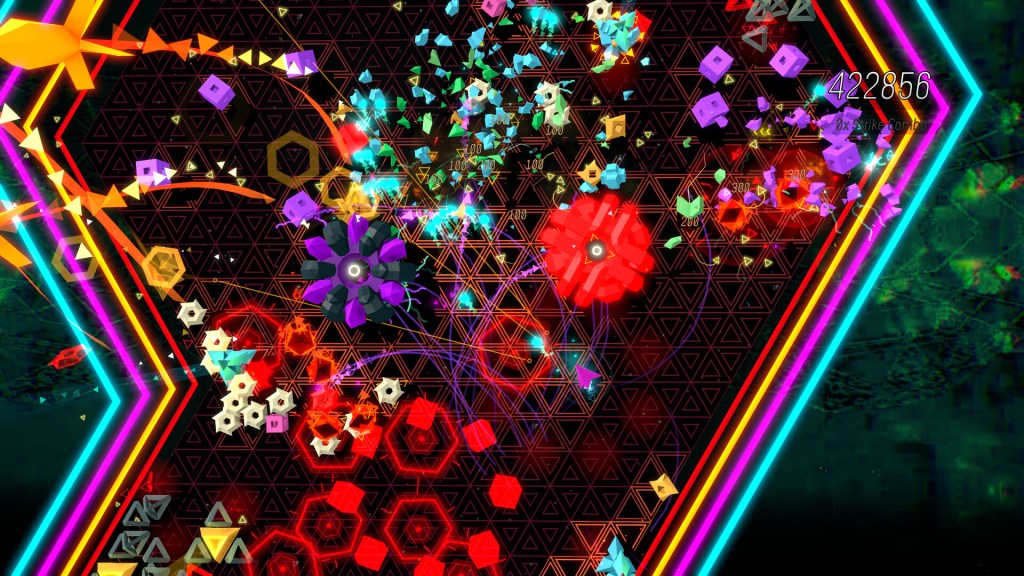
Sektori has been described by Brendon Bigley of Wavelengths as “a perfect game.” That might sound a laughable concept, but I must agree. It’s really the only correct way to describe this perfectly balanced dagger of a game. Every little thing, every bit of minutia, every god damn detail has been meticulously crafted and obsessed over in such a way in this twin-stick shooter that you can see the intentionality and mastery of Kimmo Lahtinen’s – originally of Housemarque – new masterpiece writ plain. The thumping bass accosting you at the startup screen is a perfect preparation for the heart-pounding insanity you are about to be plunged into. Sektori doesn’t initially open many doors, but instead drives you straight into your first round. There is a tutorial, however, and I highly suggest playing it. The game itself is complicated in an uncomplicated way. It is a most excellent evolution of the arcade classics of yore. I’m going to try to explain how it works, though if you haven’t experienced it first hand it’ll probably sound like the ravings of a lunatic.
It goes like this: Defeated enemies drop experience shards, which, when collected, accumulate level by level. On the left side of your screen sits a list of upgrades. Each level you’ve obtained by picking up the exp shards while avoiding an absolute onslaught of chaos awards you an upgrade corresponding to whichever level you are currently sitting at. The catch is that you need to cash in those levels to acquire said upgrade, starting your progression again from zero. In order from bottom to top is Speed, Score, Strike, Shield, Missiles, and Blaster. I’ve yet to pick up Score one single time. I don’t have time for that, my dude, I’m trying to survive here and Sektori is fucking vicious. It requires precision and mastery to make it very far at all. I have yet to defeat the third boss after about 20 hours – let me remind you, I am terrible at gaming. In this way, it is an absolute requirement that you sit in a state of pure intrinsic motivation and train yourself in this new skill. It didn’t become apparent to me until a few runs in why Speed sits at the bottom: Level One. The developers are communicating something in not only the order of the upgrades, but in every little detail. You would be wise to invest in speed early on. Again, the intentionality of it all is striking. Although Speed doesn’t seem like an upgrade of immense value, you’ll find the first boss – if you reach it – far outpacing your ship’s initial movement capabilities, and you’ll be mowed down in no time. While all this is happening, all this chaos, all this madness, all this razor sharp twitch gameplay, the stage is constantly changing shape. And if you’re caught out in a section of the stage when it disappears, your run comes to an immediate and abrupt end. Sektori holds no quarter. It requires precision and mastery to make it very far at all. But it never feels unfair. Which is an astounding feat for something that could’ve so easily felt mean-spirited. It is vicious, but never malicious. It wants you here, enjoying every gripping second. You can feel that Lahtinen wants you to do well. Everything in the game is there to aid you on your journey, you just have to listen. Sektori soon forces you, run after run, into a never ending flow-state and it is one of the most moreish games of the year. It has finally provided me with the purest, most blood pumping sense of intrinsic motivation I’ve had since… well since ever in gaming.
I know it took a long time to get to this final highest recommendation. But all that I’ve written had to be explained in order to give Sektori the due diligence in crafting the recommendation it deserves. It is unlike anything I’ve ever played, even though it pulls from obvious references. Sektori deserves, nay demands your attention. It wants you so badly to get high on its supply of intrinsic motivation. And it’s the only one out there with the best shit on the market. Kimmo Lahtinen is a monster, but one that I would follow to the ends of the earth. I’m in so deep with Sektori I fear for my wellbeing. At least this time it’s intrinsic self harm I’m inflicting, not that stepped on extrinsic shit.
The games can all be found on Steam. Rez Infinite and Sektori can also be found on consoles. Every single one of them is more than worth your time and money. Give yourself the gift of the intrinsic. Let go of everything else, if only for a while.

 gAmeDHD
Leave a comment