
Colin Clark
There’s a certain kind of peace and comfort in finality. For those of us who live with any or multiple anxiety disorders, there is a constant hum and weight of living moment to moment, day to day thinking the “yeah but what about…” thoughts. What if thing X isn’t successful? That means thing Y won’t happen! And that means I’ll never be allowed to attempt thing Z! Fuck! If I never get to attempt thing Z, then what am I doing any of this for any way? We are so product driven we lose sight of the process. We unpack every little moment and dump that minutia onto ourselves and, if we’re lucky, onto the people around us. It’s exhausting dealing with someone who is anxious all the time. It’s exhausting being anxious all the time. We must make it our prerogative to get a damn grip on our anxieties. We go to therapy and take meds about it. And then we’re anxious about trying to not be anxious! “What were my anxiety levels like today? Could I have done better to quell some of those fears? What if I never get a grip on this?” And then the spiral begins anew.
So then, after all the waiting for – and anticipation of – anxiety over a certain moment, when that moment is but a fraction of a second behind us, there’s an instant lifting of the spirits. One tiny microsecond of relief. A blip of calm before we immediately begin wondering and fretting anew about the next thing ahead of us. The hunt for that moment, and the training to make that moment last as long as we possibly can becomes a daily practice.
I have a habit of thinking to myself, say, at the beginning of a very long work day: “Remember this moment now, and then when you get to the moment when this day is complete, think back on this original before-time moment and be grateful for how far you have come and where you are now. Relish the being of done-ness.” So I clock into work, I go through the day fretting about other people, not a moment of gratitude for myself, and then on my walk home I’ll have that thought. I’ll suddenly remember the thought seed I gave myself at the beginning of the day: “When you’re walking home, be grateful you’re done. Be thankful for the day you’re given, and bathe in that relief and success, if only for that 7 minute walk.” And so I do. And it is glorious.
I get to have these beautiful moments because I have trained myself over years and years of practice and therapy to be able to feel that specific feeling. I’ve heard that people with normal brains live most of their life in this state of mind, not thinking or stressing about the what-is-immediately-in-front-of-them, but just calmly accepting that it’s a thing that has to happen. They don’t freak about every little decision leading them off onto a disparate path of life in comparison to making that decision the other way. So to us, that moment feels like absolute bliss. And we stretch that second out as long as we possibly can. Some of us have to work for that sense of peace. Some of us don’t. But I do, and if you’re here, I’m betting you do too.
It’s work. It’s actually harder work than the work we’re stressed about doing in the first place is itself. It took me years and struggles.
I have been so product driven over the years, I have stopped enjoying the process. In games, I often utilize guides to make sure that I squeeze every ounce of experience from what a developer has made. I have stopped relying on myself to think creatively, to enjoy the process, the playing of a game. Many Nights a Whisper has cured me of that particular malady. It has taught me how to play games again. How to trust myself to play games again. I’m going to tell you now that MNaW broke me down. It made me cry and it made me lament how I’ve been playing games in recent years. I’m asking you now to remember this moment, so that when I get to my actual point in this piece, you remember how we started.
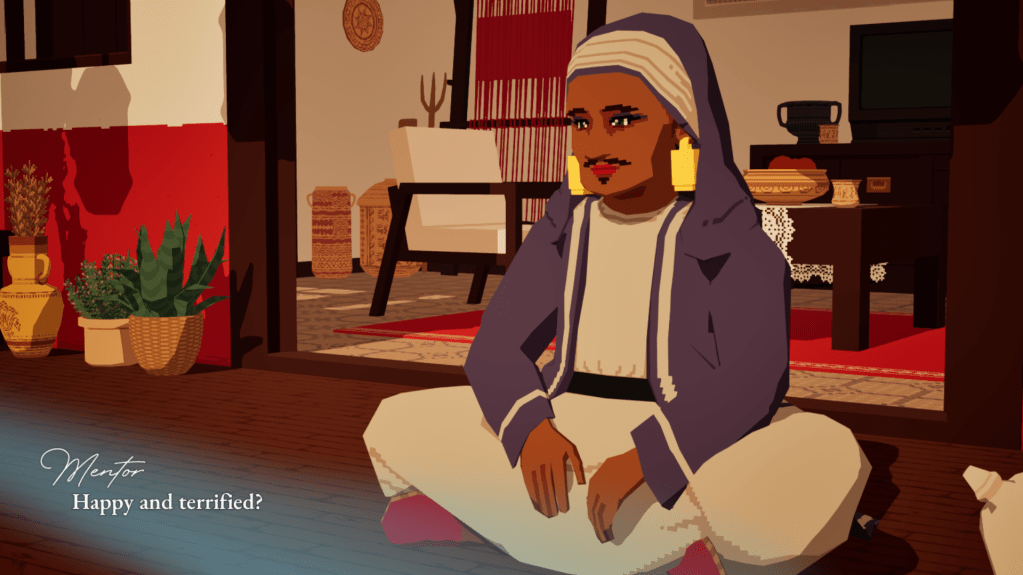
Many Nights a Whisper distills this complex and troublesome concept down into an hour and a half masterclass on pressure and relief. We play as The Dreamer. She was chosen ten years ago as a child to be The Dreamer. It is her responsibility to make sure everyone’s dreams come true. And if she fails, those Dreams will never come true. Not now, not ever. Her make or break moment comes as one chance to light a chalice far off out into the ocean – just on the edge of reach – with her slingshot made of Villagers’ hair. She spends her days learning from The Mentor, who has raised her from childhood leading up to this very singular, very isolated One Act Play – One Chance Chance. The Mentor poses questions for The Dreamer. He forces us to contemplate the why not the what. I find it hard to not make the comparison between a therapist and their client. Yes, The Mentor has wisdom that The Dreamer does not yet possess, but it is The Mentor’s job to make sure The Dreamer gets there of her own volition. Of their own mental faculties that those lessons might stick a little harder. The Mentor asks The Dreamer about the nature of herself, The Villagers, and the goal. About what it means, not what it is. And The Dreamer is grateful – at least I thought she was, and I thought I was. I had no idea.
Every night during the last week of this ten year life of isolation and meditation The Dreamer kneels beside a wall. The villagers, one by one, slide their long hair braids through the hole in the wall and offer up their Dream to The Dreamer. If The Dreamer finds The Dream acceptable, she cuts off the long, long braid of hair with her long, long knife. The Mentor then weaves the hair from this braid into The Dreamer’s sling shot, making it more and more powerful as the last days go by. The Dreamer spends her day training with target practice on chalices that were built by a previous Mentor. She gets a sense of the aiming, the power, the angle, and the approach of each slingshot shot. She starts small and close. The first chalice she hits prompts an achievement on Steam. There is one hidden achievement per chalice to be collected and read. Each achievement is a small poem fleshing out the world of Many Nights a Whisper. Cryptically worded at times, each and every one stimulating and fulfilling and questioning, these Steam achievements are the fourth character of our one act game. There is The Dreamer, there is The Mentor, there are The Villagers, and there are The Achievements. These four parts come together to weave a particularly beautiful and poignant tale.
At this point, I suggest you go play the game yourself. It’ll cost you three bucks, and it’ll take 90 minutes of your time. For something as profound, moving, funny, sad, and beautifully crafted as this, you almost owe it to Deconstructeam to give their game a go. Following there will be spoilers. You have been warned.
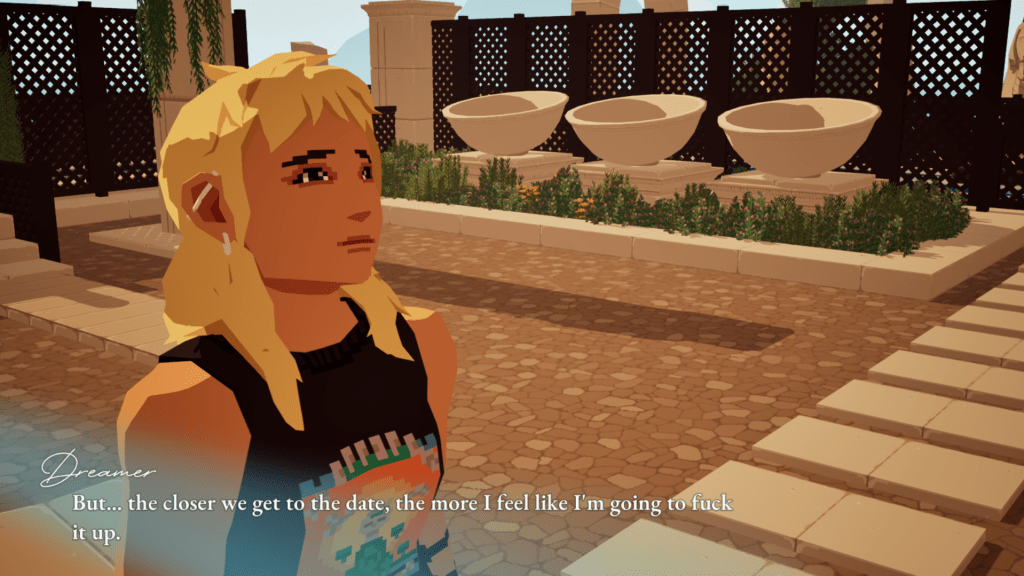
Each Dream asks of us a new philosophical question. It’s up for us to decide whether The Dream is worthy of coming true. Whether it is safe or right for that Dream to come true. That responsibility is ours and ours alone. One Dream in particular hit me harder than all the others. The Villager slid their braid through the hole and explained to me their quandary. It was as if I – me, Colin – were speaking to The Dreamer through the wall. The Villager battled with the idea of gender. They felt all genders and also no gender. They were confused by gender, by the weight society had placed upon such an arbitrary thing. They noted that they had taken a vacation to house sit for their family for a week on a lake. They had no cell service, no one else to talk to. They just were. They just existed as themselves outside of the label society had placed upon them for whatever gender they had happened to have been born as. They said it was the happiest they have ever been. And then they asked for the idea of gender to cease to exist. Not only that the binary be erased from human consciousness, but the very idea of gender itself. On my first play through I thought “Well, yes, I would love for the concept of gender to be erased. But that would affect so many other people in the way they view themselves. It simply isn’t fair of me to make that decision based on how I view gender. To strip that comfort away from others who find comfort in it? No thanks, that’s the wrong decision.” So I didn’t cut the hair. And I let The Dream die.
Jumping far ahead to the final day – the night of the ceremony – I had trained each day to make this one shot. I had studied how The Dreamer’s body lined up with the trees, and the chalices, and the surroundings to mark exactly how she should stand to make the shot. But then the night came and when it was finally time for that one shot, the game took away half of my markers in the landscape to line up the shot. Hilarious and cruel and fair and fitting all in one, I had to laugh at myself. Of course. It had to come down to feeling. It was simple: feel the shot. So I did. And the fireball sailed. And I watched it arc over the ocean. And I held my breath. And then it sailed directly over the ceremonial chalice way-a-ways out there in the ocean. And it fell lifelessly into the water beyond. And no one’s prayers were answered. And no Dreams ever became reality. And then. And then it was over. And then a sense of relief washed over me as it was described washing over The Dreamer herself.
When I play, for example, an RPG, I – at the very least – look up a guide on suggested builds, areas to look out for, recommended items and weapons, and moments that can be missed. Just general things to be aware of. Because I want to play the game right, god dammit. I don’t want to miss anything! I trap myself into this product over process journey in every game I play, and I lose a sense of creativity and self-fulfillment and wonder along the way. My mother has always lauded process over product. I have forgotten that lesson, it seems. In the time I’ve spent playing Clair Obscur: Expedition 33, I have – at all times – kept my laptop open in front of me with a selection of guides open for myself to reference along the way. Because I want to do it right. I want to experience the game the best way possible.
So, with this in mind, it’s probably obvious that I spent every day in Many Nights a Whisper lining up that final shot over and over and over again. Getting it just right so that I could walk up, line up my elbow and angles with the landscape and the trees and the sky and dunk that fireball into that chalice without fail. So then when the game took much of that landscape away from me, I was royally and unequivocally fucked. I should’ve known. And then – while this may sound like the most obvious statement in the world – it dawned on me. Playing games are about feeling. About the journey. About learning as you go. About understanding the mechanics and concepts deeply. Not about having someone else tell you how the “best way to build Gustave” is this or that particular way. It’s so much better to learn these things yourself. To experiment. To actually learn something and take something away, creatively, from a game.
So when I failed that final shot, I learned a lesson I wish I had let myself learn ages ago. Playing games is for the fun of playing games. For the creativity that games allow us to express through our own actions. To feel out and shape our experience for ourselves in a way no one else will ever experience it. Griffin McElroy’s famous complaint rang loud in my ears that moment I failed the shot: “Play in this space with me!” If I wanted simply to experience a story, say, or for my Orbment layout in Trails in the Sky to be perfection, or for each notch on a talent tree be dictated to me, to have every decision about my gameplay made by someone else… then I might as well save myself the effort and read a book or watch a movie, god dammit.
I sat in silence for more than a moment. I didn’t even read the credits. I cried a little. I swear to you I broke the fuck down. I have spent the last 30-plus years of my life lauding the experiences only video games give to us as a medium that other forms of entertainment simply can’t afford. How good for your brain they can be, how they connected people, how you have to give something of yourself to them. And somewhere along the way I lost that magic myself. The creative thinking, the freedom, to make my own damn choices. Many Nights a Whisper gave that magic back to me. So I got up, and I gave my cats some treats, and I paced and I perched like I do. And then I booted up the game again from the beginning. And this time I made different decisions. I decided to do away with gender – as before I had thoughtfully taken into account how that would affect others – and I did let smoking be healthy for everyone. I stopped thinking so much about the right answers for the right outcome for The Villagers and I started making the decisions that were right for The Dreamer. That were right for me.
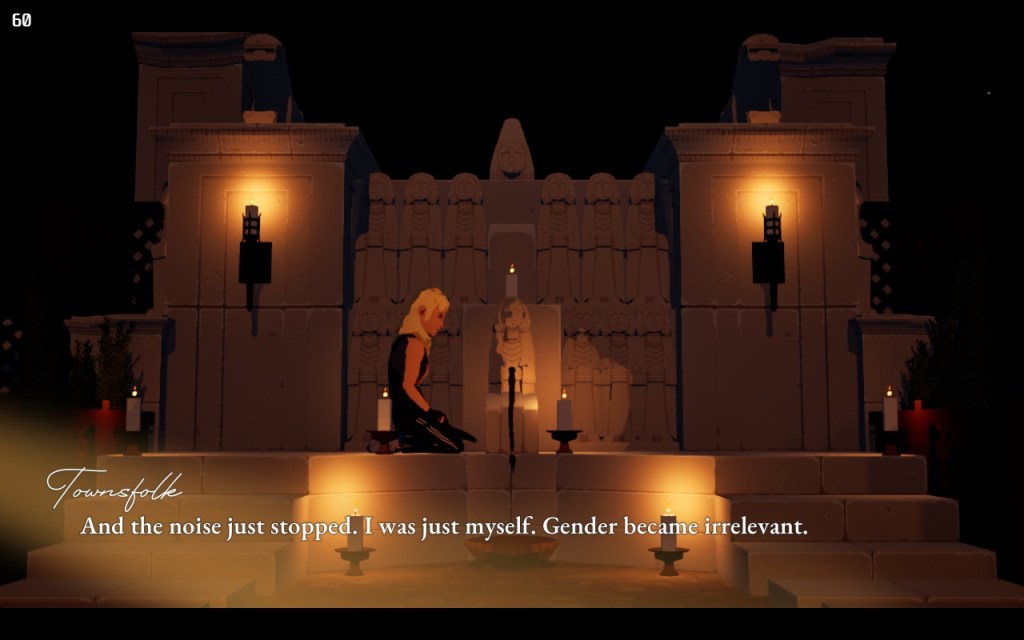
And then the last night came again. And this time I knew what was coming. This time I had let that one Villager start their life over as they had asked. Because if I was getting another shot at playing this masterpiece, to learn from my mistakes and do it the right way for me, then that one Villager sure as hell deserved a second chance as well. And I aimed, not taking notice of my surrounding landscape, but feeling the shot. I aimed at that far off chalice like I knew instinctively I could. Because I had learned what it is to play games again. And I learned how to appreciate a second chance. And to learn something for myself from a game and from my own brain, not from a guide. And let me tell you:
I sunk the shot.


 gAmeDHD
Leave a comment